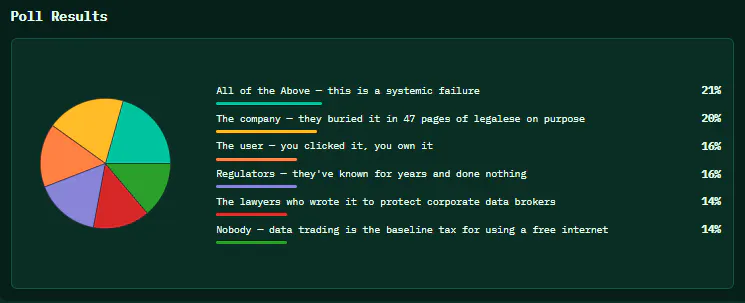
Who is to blame for the deceptive trap of Terms and Conditions agreements?
Hey Hackers!
Welcome back to 3 Tech Polls, HackerNoon's Weekly Newsletter that curates Results from our Poll of the Week, and 2 related polls around the web. Thanks for voting and helping us shape these important conversations!
Every day, on nearly every website and app you open, a box pops up. You click "I agree." You move on. And somewhere behind that click, your data quietly changes hands. The HackerNoon community this week questions whose fault that is.
HackerNoon Poll
Who is to blame for the deceptive trap of Terms and Conditions agreements?
A Carnegie Mellon study found that reading every privacy policy an average internet user encounters in a year would take 76 full working days, or the equivalent of 15 work weeks spent doing nothing more than reading legal documents. That number was calculated over a decade ago. The internet has only gotten more complex since.
...
Copyright of this story solely belongs to hackernoon.com. To see the full text click HERE