

Your robot can’t be smart, fast, and free. Evolution solved that already.
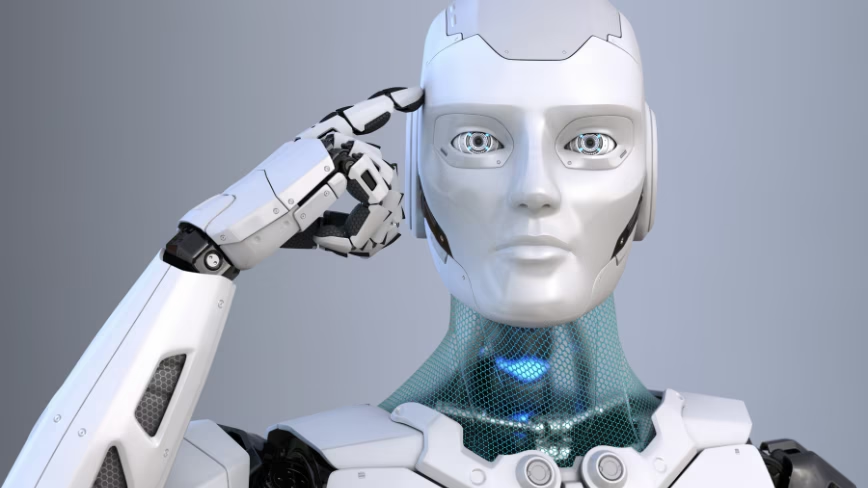
Here is a constraint that almost no one building physical AI says out loud, even though every one of them is quietly fighting it.
A robot’s intelligence wants three things at once. It wants to be smart, meaning it can reason at the level of a frontier model about an unfamiliar scene. It wants to be fast, meaning it responds inside the tight, deterministic timing a physical control loop demands. And it wants to be free, meaning it keeps working when the network drops, the warehouse Wi-Fi dies, or the machine goes somewhere no signal reaches.
You cannot have all three on one piece of compute. Pick any two.
To be precise, bounded autonomy already works. Industrial arms, drones, and constrained autonomy stacks can be fast and offline because their tasks are narrow. The trilemma bites at the frontier: you cannot put frontier-scale general reasoning, deterministic real-time response, and full...
Copyright of this story solely belongs to thenextweb.com. To see the full text click HERE