

When Fast SQL Turns Slow: Detecting Query Performance Regressions Before Production Suffers
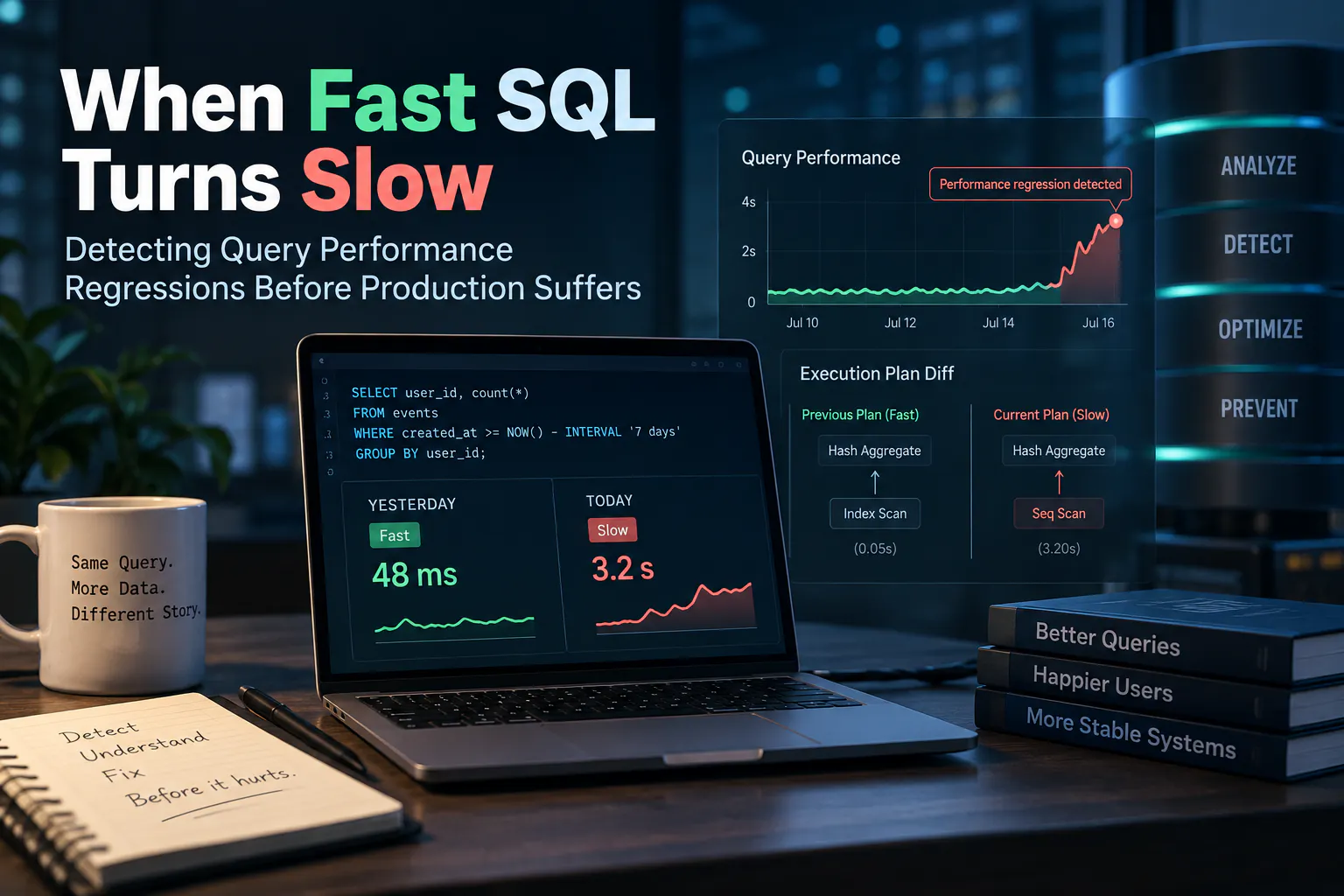
SQL performance failures rarely begin as outages. A query that completes in 40 milliseconds can drift toward 400 milliseconds as tables grow, value distributions shift, cache behavior changes, or the optimizer selects a different plan. PostgreSQL’s planner bases decisions on statistics and estimated costs, while EXPLAIN ANALYZE exposes gaps between estimated and actual row counts. Regression detection is therefore different from slow-query logging as the goal is to detect a meaningful change relative to established behavior before an absolute threshold is crossed.
A practical detector needs stable query identity, historical latency distributions, and enough execution context to explain change. PostgreSQL exposes most of the required primitives, so a lightweight Python and SQL service can add baselining, anomaly scoring, plan comparison, and CI enforcement without becoming a full observability platform.
Identity Before Measurement
Raw SQL text is a poor time-series key because literal values create artificial cardinality. PostgreSQL’s pg_stat_statements addresses that...
Copyright of this story solely belongs to hackernoon.com. To see the full text click HERE