

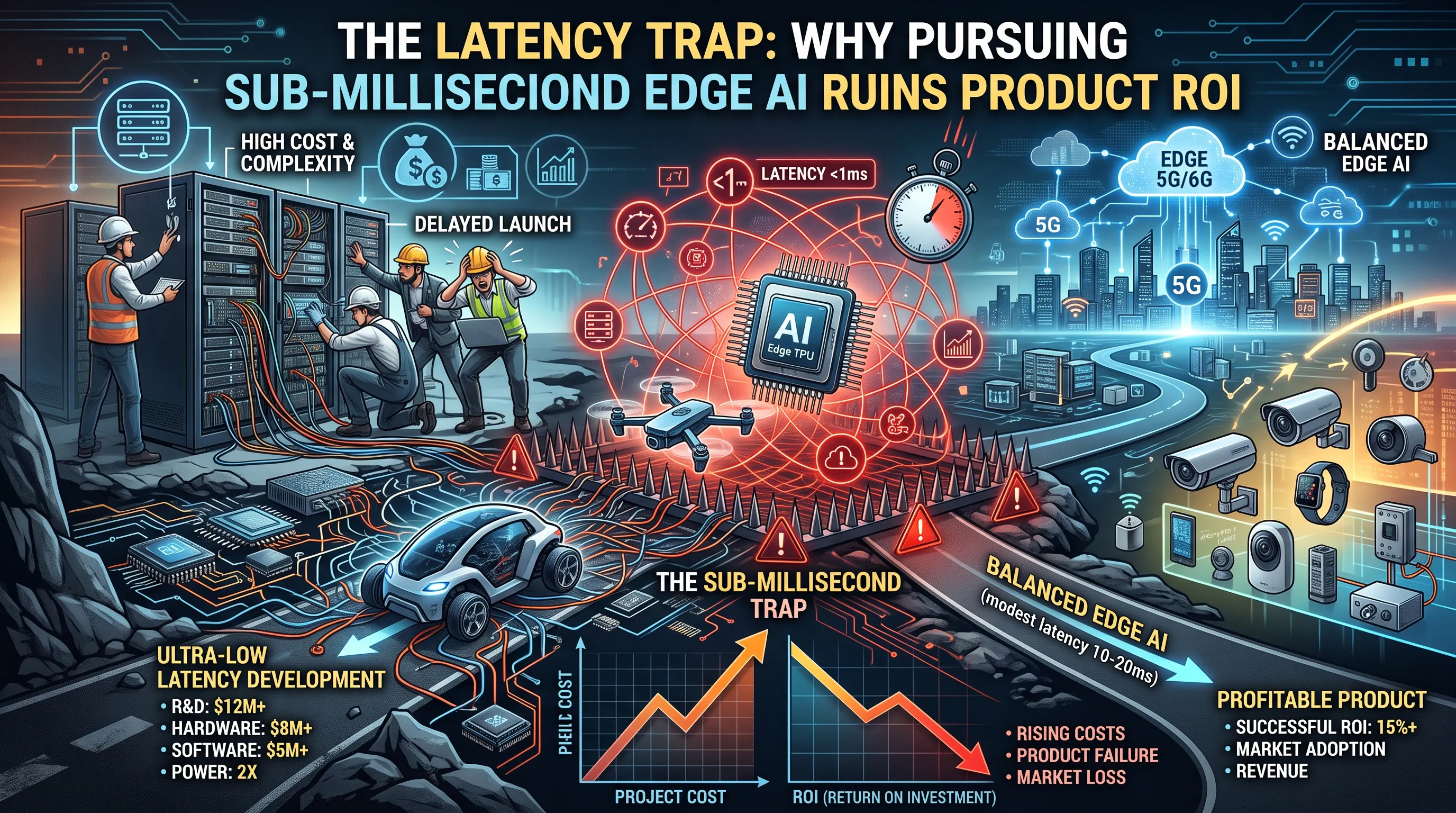
The Latency Trap: Why Pursuing Sub-Millisecond Edge AI Ruins Product ROI
Every Product Manager knows the golden rule: Build for customer outcomes, not vanity metrics.
Yet, in Edge AI product roadmaps, sub-millisecond latency has become the ultimate vanity metric.
The Strategy Flaw: Solving a Metric, Not a User Need
Engineering teams often push to minimize latency at all costs, assuming faster is always better. But tuning an edge deployment for sub-millisecond inference when the user only requires 100ms response time is like putting a rocket engine on a delivery van: it skyrockets operational costs without improving the core value proposition.
The Product Reality Check
Unless your product controls closed-loop robotics, autonomous collision avoidance, or high-frequency trading, an end-to-end response time between20ms and 100msmeets the threshold of "perceived instantaneity" for human users and enterprise workflows.
The Fundamental Strategic Trade-Off
- The Microsecond Speed Approach: Skyrocketing hardware BOM costs, fragile and jitter-prone architectures, and over-engineering for synthetic benchmarks rather than real-world conditions.
- ...
Copyright of this story solely belongs to hackernoon.com. To see the full text click HERE