

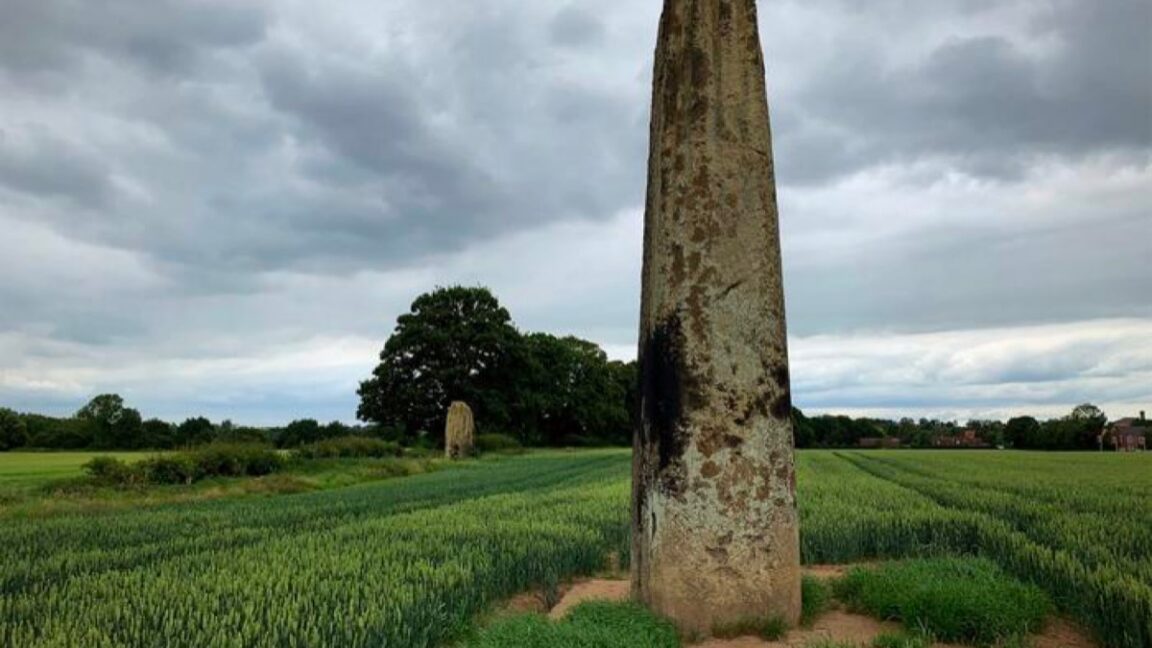
Prehistoric builders transported Devil's Arrows 11 miles
Clarke et al. took samples from all three Devil’s Arrows stones, as well as from the Battle Cross monument and Peg Bridge, using small sections of adhesive tape applied to inconspicuous areas of the stones free of lichens or mosses. Grain samples stuck to the tape and were later removed by dissolving the tape glue with mineral turpentine. They removed coarse magnetic materials and light minerals like quartz and feldspars, and imaged what remained in the samples using field emission scanning electron microscopy. They also performed an isotopic analysis of zircon and apatite minerals to get an age “fingerprint” in order to match the stones to their likely source.
The Devil’s Arrows are made of a coarse-grained sandstone. Plumpton Rocks, which is closer to the Devil’s Arrows, had previously been identified as the probable source of the stones. Based on their analysis, Clarke and his team concluded that the most...
Copyright of this story solely belongs to arstechnica.com. To see the full text click HERE