Operational Dark Matter: Why Mature Systems Keep Surprising Engineers
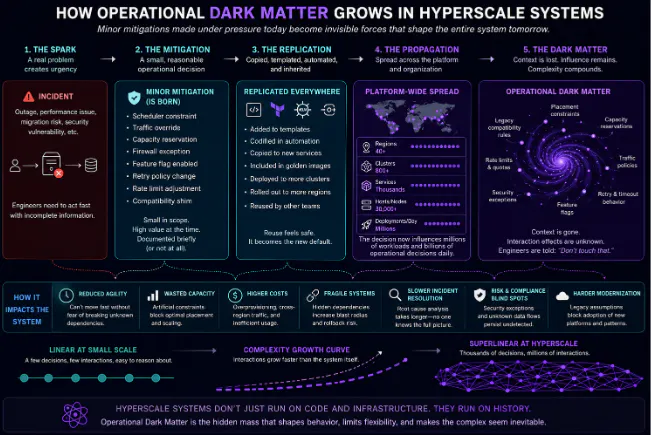
The most threatening parts of modern infrastructure are often not the ones engineers cannot see, but the ones everyone stopped remembering.
Incident
At 2:17 a.m., I was convinced we were chasing a network problem. My team was 3 hours into diagnosing a slowdown event that impacted compute capacity allocation across a fleet of thousands of servers.
Customer facing latency increased and service degradation was worsening. However, amongst this chaos, the dashboards contradicted the situation that was unfolding in front of us. Saturation metrics read within limits, memory utilization, app configurations and throughput all appeared healthy. I looked for evidence of usual issues such as noisy neighbors, overloaded dependencies or bad deployments. Each hypothesis proved incorrect under the evidence, the system was still reporting and monitorable, yet the customer experience continued to degrade.
After hours of digging, the root cause was eventually found. It was not a failing component but was...
Copyright of this story solely belongs to hackernoon.com. To see the full text click HERE