

Modal Logic & Neural Networks
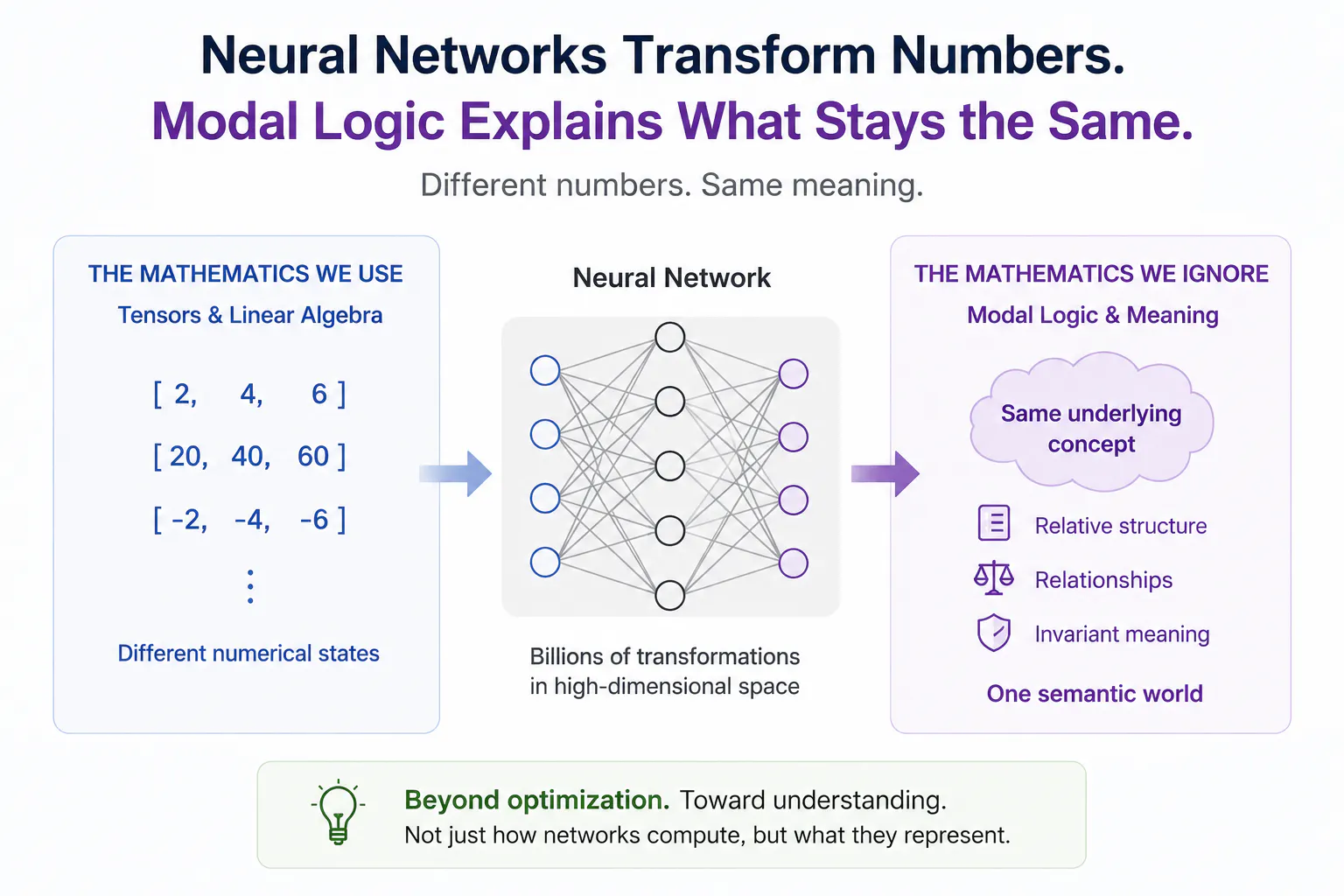
The Mathematics We Use vs. the Mathematics We Ignore
Artificial intelligence is almost universally described through optimization. Ask why Layer Normalization exists and you'll hear that it stabilizes gradients. Ask why Batch Normalization exists and you'll hear that it improves convergence. Residual connections help gradients flow, attention mechanisms compute weighted relationships between tokens, and feed-forward networks transform latent representations. None of these explanations are incorrect—they explain how neural networks train. What they rarely attempt to explain is what these operations represent. I think modal logic provides an interesting framework for studying neural networks because it shifts the discussion away from optimization and toward representation itself. Rather than asking how tensors change numerically, modal logic asks what information remains necessarily true as those tensors change.
Different mathematics. Same semantic conclusion.
Suppose a layer produces
The mean is
the standard deviation is
and the normalized output becomes
[−1.225, 0, 1.225].[-1.225,\;0,\;1.225].[−1.225,0,1.225].
Now suppose...
Copyright of this story solely belongs to hackernoon.com. To see the full text click HERE