"Little red dot" in early Universe is a naked supermassive black hole
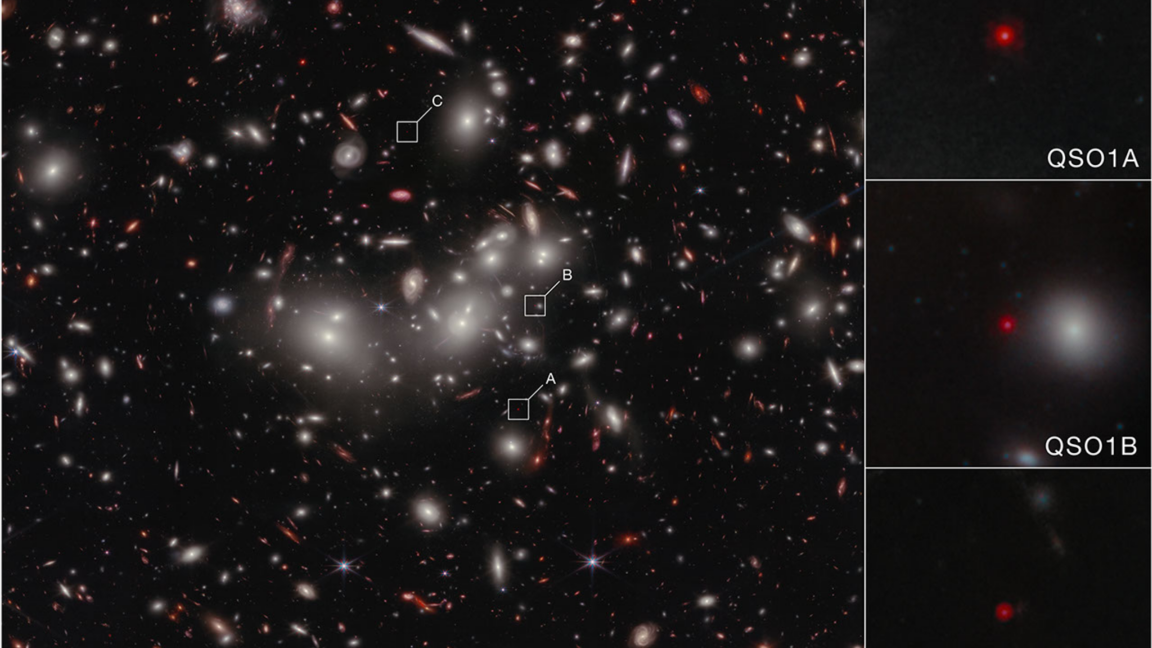
These models placed the black hole’s mass at about 50 million times that of the Sun, which is in line with previous estimates. That suggests the rules governing black hole luminosity haven’t changed in at least 13 billion years.
Attempting to estimate the mass of any stars surrounding the black hole suggested there were very few. “The Keplerian rotation curve leaves little room for any stellar component,” the researchers conclude. Attempts to estimate the total stellar mass in the “galaxy” that the black hole sits in came up with an upper limit of 20 million solar masses—less than half of the mass of the black hole itself.
In other words, over two-thirds of the mass of QSO1 resides in the black hole, with the stars accounting for less than one-third. Which explains why the word ‘galaxy’ is in quotes above. “To our knowledge, this upper limit makes QSO1 the most...
Copyright of this story solely belongs to arstechnica.com. To see the full text click HERE