
How to Build Production-Grade Applications With AI
Starting With the Right Shape of Problem
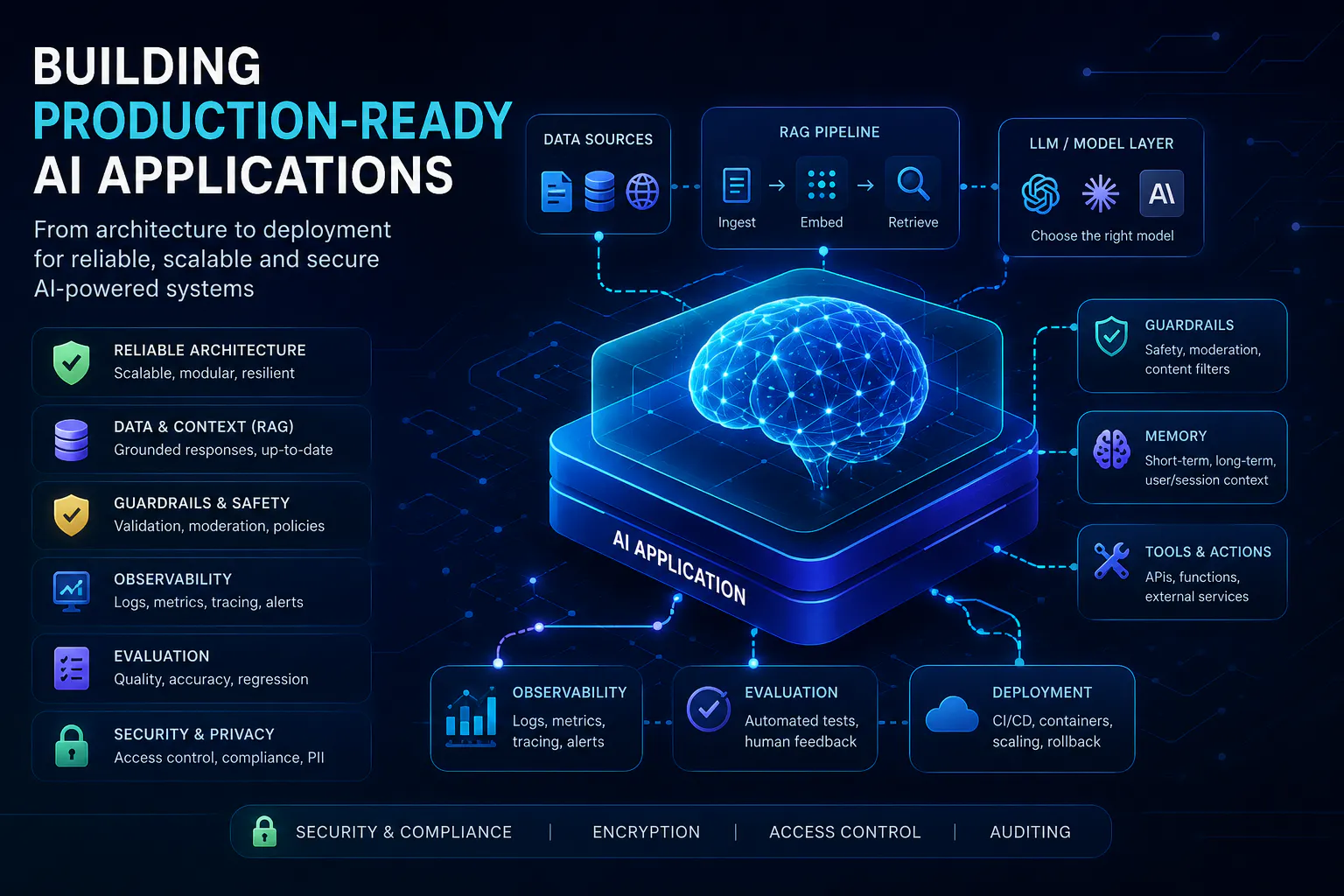
Building with AI becomes difficult only after the demo works. Real systems must survive noisy inputs, latency budgets, legal review, cost ceilings, and operational incidents. That is why current platform guidance increasingly frames generative AI as a software and operations problem rather than a prompt-writing problem. OpenAI’s production documentation focuses on secure access, scaling, rate controls, staged environments, and latency management, while Microsoft Foundry and Amazon Bedrock pair model access with evaluation and monitoring capabilities. NIST’s Generative AI profile pushes the same idea further by framing trustworthy development, use, and evaluation as lifecycle concerns rather than one-time checks.
That perspective changes what “production-ready” means. A production AI feature is usually narrow, bounded, and measurable. Classification, extraction, summarization, grounded search, and assisted workflow routing are easier to control than open-ended autonomy. Anthropic’s guidance on effective agents recommends simplicity, transparency, and careful tool design, and...
Copyright of this story solely belongs to hackernoon.com. To see the full text click HERE