
Designing Reliable AI Agents With Bounded Context and Tool Guardrails
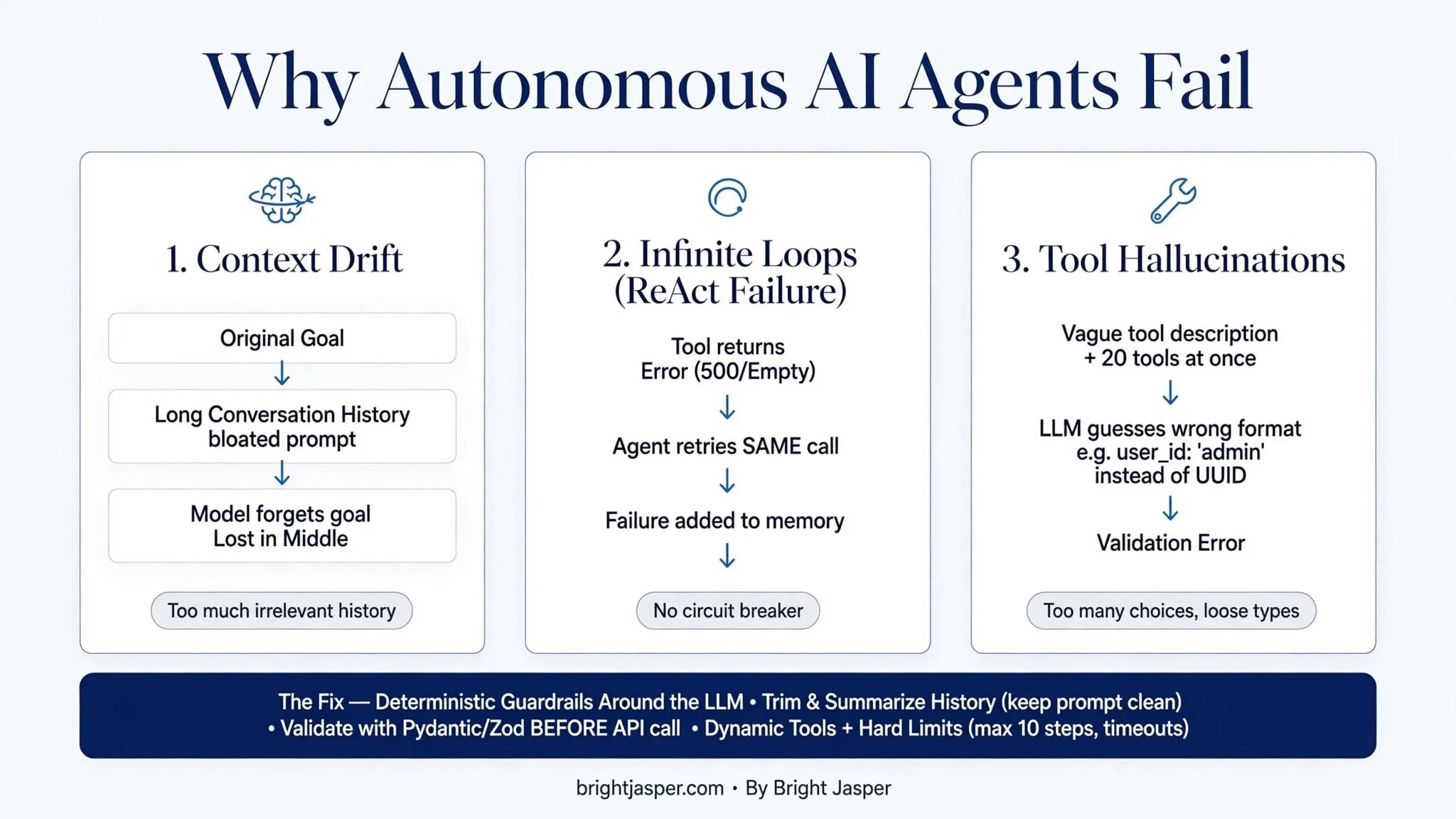
Autonomous AI agents fail in production mainly because of context drift, infinite execution loops, and poor tool interface design. As tasks grow longer, agents lose track of their original goals and start making invalid API calls or repeating mistakes.
When you build a basic wrapper around an LLM, it handles single questions well. But production agents run inside loops (like the ReAct framework) to solve multi-step problems. They break down a goal, pick tools, run them, and inspect the results. The problem? Every step adds noise, and without proper guardrails, the agent's accuracy drops sharply after just a few turns.
What is the ReAct loop and why does it fail?
The ReAct (Reasoning + Acting) loop is an architecture where an LLM alternates between thinking and calling tools until it solves a problem. ReAct loops fail when an unexpected tool response causes the agent to retry the exact same action...
Copyright of this story solely belongs to hackernoon.com. To see the full text click HERE