

Choosing a Python Sentence Boundary Detection Library
Sentence boundary detection sounds boring. Split on . ? !, done, right? Anyone who has tried knows otherwise. Abbreviations, decimals, URLs, nested quotes, ellipsis, legal citations, biomedical jargon—each one turns "split text" into a language-specific puzzle.
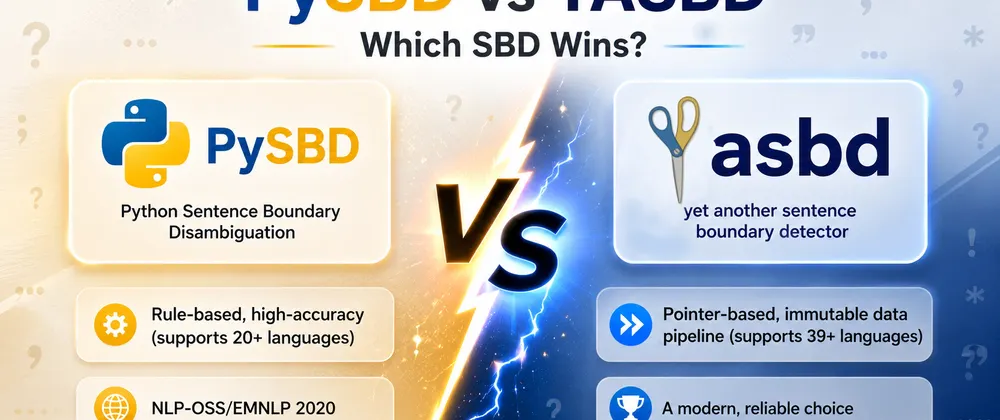
Two Python libraries tackle this problem with different philosophies. pysbd has been the go-to since 2020 with 23 languages, ported from Ruby's pragmatic segmenter [1]. yasbd-lib is newer, covers 39 languages, and takes a different architectural approach.
This is the difference between protecting boundaries and finding them.
Architecture: Mutation vs. Pointers
To understand how these engines behave on large datasets, we have to look at how they treat input strings.
PySBD: The Transformation Pipeline
pip install pysbd -U
PySBD operates as a multi-stage transformation pipeline [1]. It treats text as a mutable object that must be modified before it can be split [1]. To prevent punctuation within abbreviations, numbers, or URLs from triggering false...
Copyright of this story solely belongs to hackernoon.com. To see the full text click HERE