
Can Persistent Tries Beat LMDB? Leaves Database Benchmarked
The database literature has long centered on a small set of storage architectures: B-trees, LSM trees, and their many variants. This article examines a different approach: a persistent trie design for embedded key-value storage.
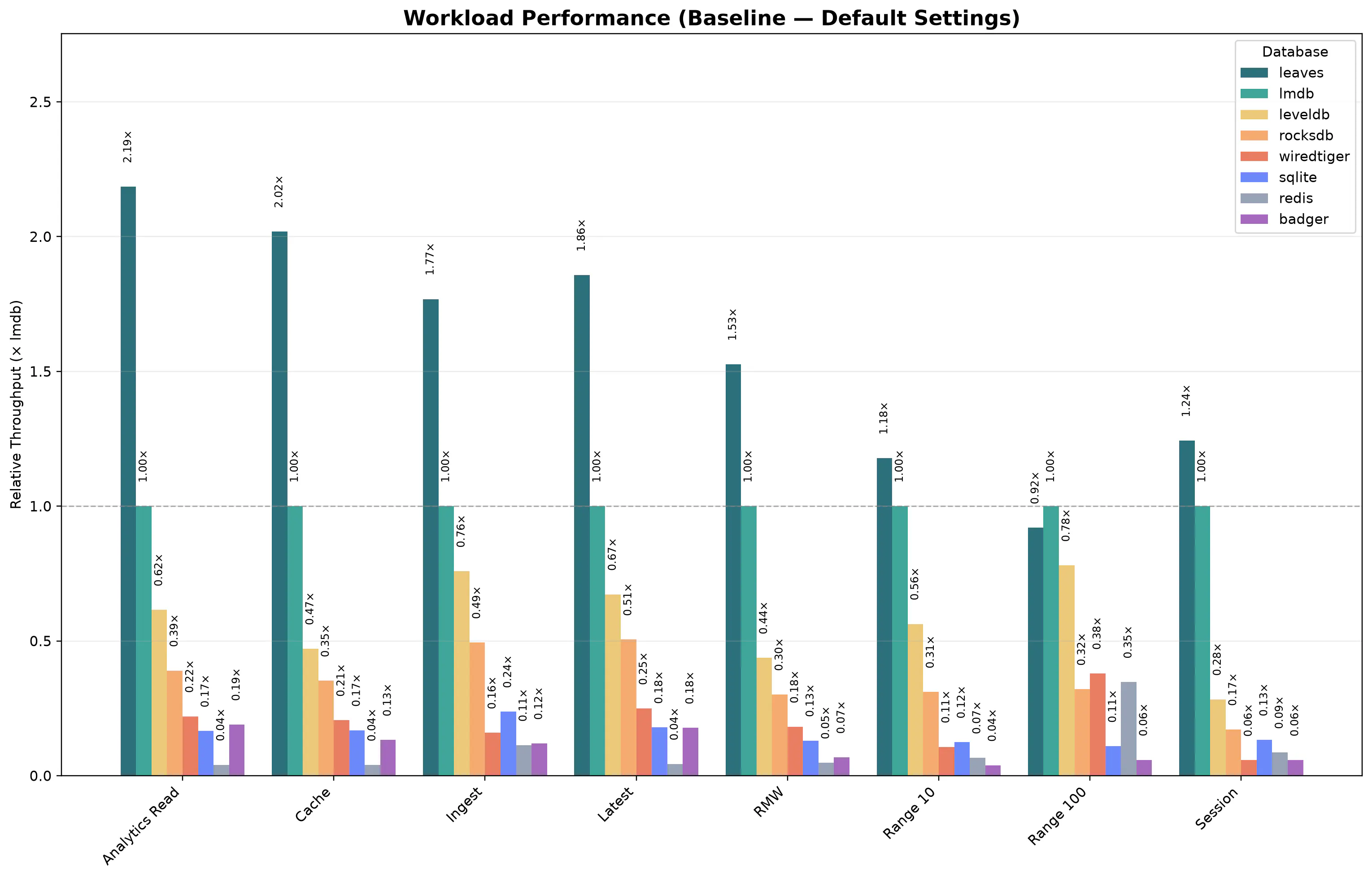
To make the comparison concrete, the evaluation includes LMDB as a widely used high-performance baseline. Most published benchmarks omit LMDB entirely, which makes it difficult to interpret what “fast” means in practice. This article therefore uses LMDB as a reference point and compares it against a range of widely used engines under comparable conditions.
All databases are configured for high performance using recommended and engine-specific settings where applicable. This includes batching, cache sizing, binary keys, and other engine-specific optimizations. ACID workloads are evaluated separately with strict durability enabled.
The goal is simple: measure how these systems perform against a known high-performance reference.
The results suggest that a persistent-trie design can be highly competitive, and in several...
Copyright of this story solely belongs to hackernoon.com. To see the full text click HERE