
1970 exploitable findings later.
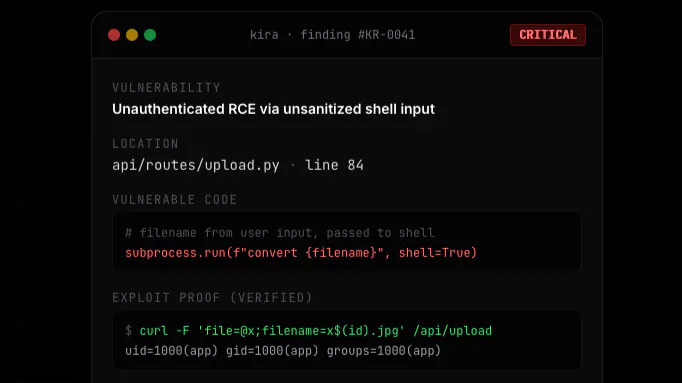
Been a while. We were busy hacking. Ethically, of course.
Over the last few months, we’ve been building Kira: an AI security agent that reviews code the way a security researcher does. Not by matching patterns or blindly flagging sinks, but by reasoning about exploitability. What assumptions does the system make? Where do trust boundaries shift? Which components interact in ways nobody modeled? And sometimes more importantly: which findings are technically real, but operationally irrelevant?
We started with benchmarks. Then we pointed Kira at real production systems.
That’s when a pattern became impossible to ignore.
Most security tooling still analyzes software the way applications looked five years ago: isolated files, isolated vulnerabilities, isolated sinks.
But modern vulnerabilities rarely live inside a single component anymore.
They emerge in the seams between otherwise correct systems.
The sanitizer works. The middleware works. The webhook handler works. The ORM works. The auth layer works.
...
Copyright of this story solely belongs to hackernoon.com. To see the full text click HERE